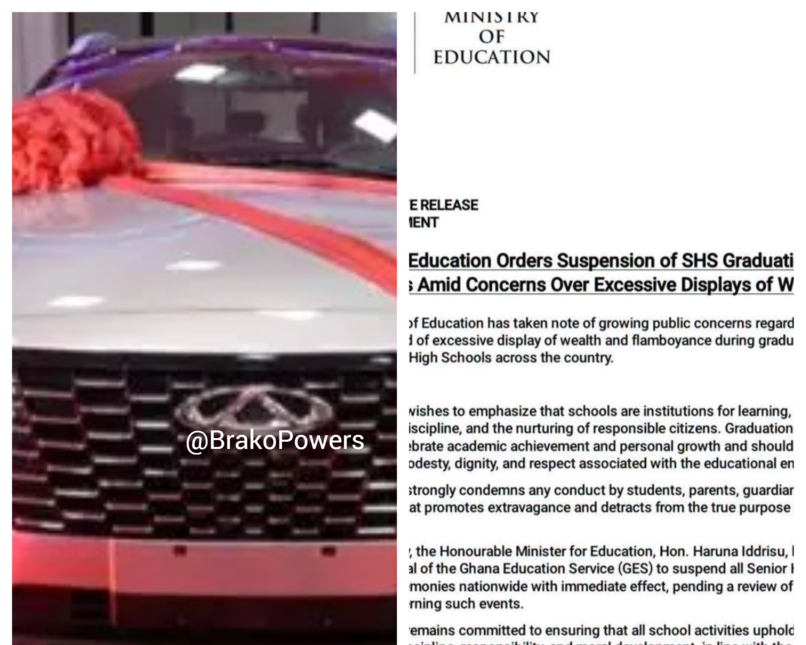
The recent public debate triggered by a viral video of a parent gifting her daughter an SUV upon completing Senior High School has once again exposed how quickly social media controversies can shape national conversations. What began as a private family celebration has now evolved into a broader discussion about values, discipline in schools, and the direction of education policy in Ghana.
The debate intensified further following a directive from the Minister of Education instructing the Director-General of the Ghana Education Service to suspend all Senior High School graduation ceremonies nationwide, pending a review of existing guidelines dated June 20, 2026. While this directive is now part of the official administrative response of the Ministry, it raises important questions about proportionality, policy direction, and the proper role of education regulation.
At the heart of the original controversy is a simple issue: a parent choosing to reward her child for completing SHS with a significant gift. Whether one considers an SUV an excessive or appropriate reward is ultimately a matter of personal judgment, shaped by individual values and financial capacity. However, from a legal and policy standpoint, there is nothing unlawful about a parent gifting property to their child. It is an exercise of private ownership and family autonomy, protected within the broader constitutional framework of property rights.
The swift public backlash, however, reflects a growing tension in Ghanaian society between private choices and perceived social expectations. Some argue that such displays create undue pressure on other parents and students. While that concern is understandable, it is difficult to sustain the argument that one family’s private expression of celebration should be restricted because others may feel compelled to emulate it. Public policy does not ordinarily regulate private generosity simply because it is visible or aspirational.
More troubling is the apparent policy response. If the Ministry’s concern is that some Senior High Schools are drifting from their core academic purpose, that concern is not without merit. There have been longstanding debates about discipline, student conduct, academic standards, and the growing influence of social media on school culture. However, these are structural issues that cannot reasonably be attributed to a single graduation gift or ceremony.
Indeed, if the Ministry is genuinely concerned about preserving discipline and educational standards in our schools, there are far more pressing matters deserving urgent attention. In recent years, there have been disturbing reports of inappropriate relationships and sexual misconduct involving teachers and students in some schools, including the widely publicized incidents at Bole and elsewhere. Such incidents raise serious concerns about student safety, professional ethics, safeguarding mechanisms, and accountability within educational institutions. They strike at the heart of the educational environment and have far greater implications for the welfare and development of students than a parent’s decision to reward a child with a vehicle.
Similarly, concerns about academic performance, examination malpractice, indiscipline, bullying, drug abuse, inadequate infrastructure, and teacher absenteeism continue to confront many schools across the country. These are the issues that directly affect the quality of education and the future of Ghanaian students. They demand sustained policy attention, resources, and institutional reform.
It is therefore important to distinguish between a symptom and a cause. The gifting of an SUV to a student did not create the challenges facing Ghana’s Senior High Schools. Nor can the suspension of graduation ceremonies, on its own, be expected to resolve those challenges. Graduation ceremonies are symbolic academic milestones observed in educational institutions around the world. Where excesses exist, they can be addressed through clear guidelines and effective supervision rather than broad restrictions that may inadvertently punish schools that have conducted such ceremonies responsibly.
Public policy should be guided by evidence, proportionality, and a clear understanding of the problem being addressed. Reactive measures driven by viral incidents often create the appearance of decisive action while leaving deeper systemic challenges untouched. Educational reform requires more than responding to the controversy of the day; it requires confronting the issues that have persisted for years and continue to undermine learning outcomes and student welfare.
Ultimately, the real question is not whether a parent should gift an SUV to a child. The more important question is whether Ghana’s education system is focusing on the matters that truly affect students’ lives and educational outcomes. If the objective is to strengthen discipline, improve academic standards, and protect students, then policy efforts should be directed at the deeper challenges confronting our schools rather than symbolic controversies that dominate public attention for a few days.
The SUV gift may have generated headlines, but it is not the crisis facing Ghanaian education. The real challenge lies in creating safe, disciplined, accountable, and high-performing schools that prepare young people for the future. That challenge will not be solved by suspending graduation ceremonies. It will be solved by confronting the systemic issues that have long demanded our attention.
==
About the author:
Austin Kwabena Brako-Powers is a legal practitioner, international trade expert and a researcher based in Accra, Ghana.
Be First to Comment