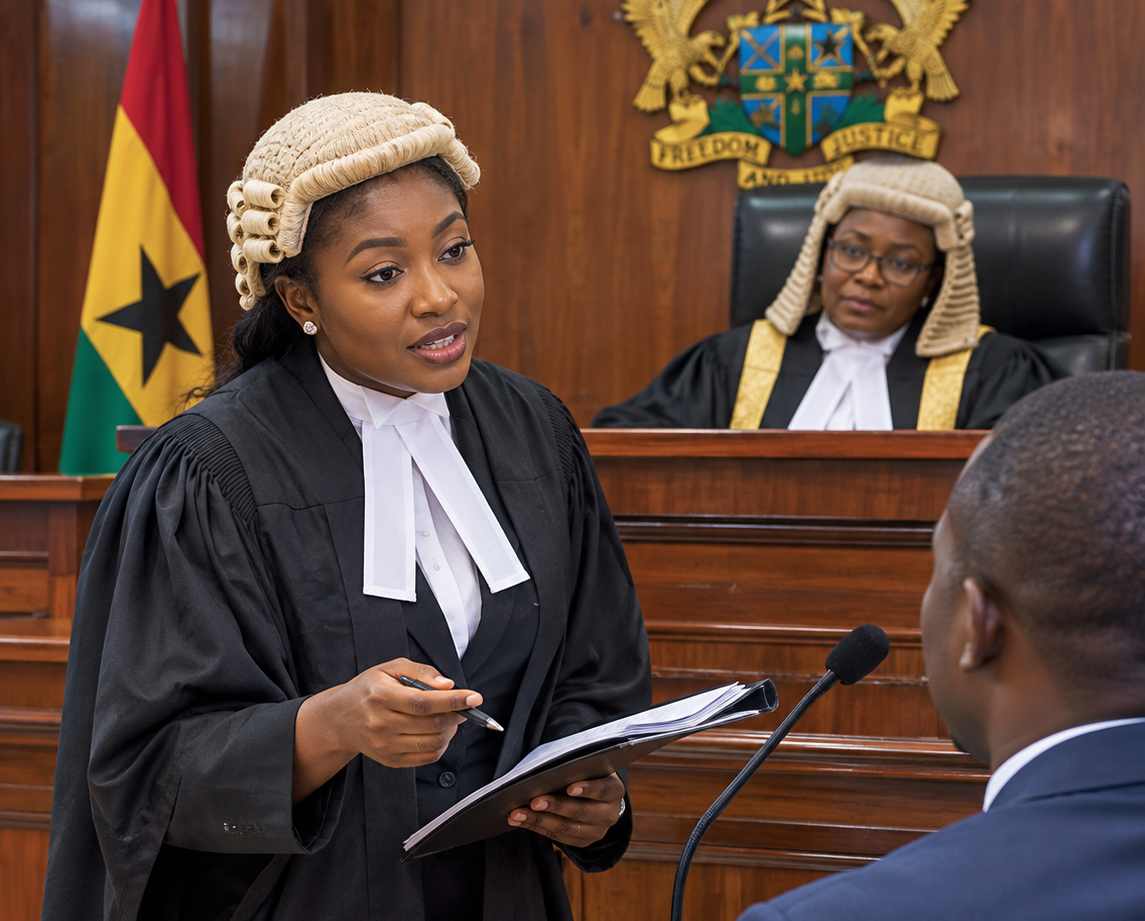
In criminal litigation, the burden of proof rests firmly on the state. Under Article 19(2)(c) of the 1992 Constitution of Ghana and Section 11(2) of the Evidence Act, 1975 (N.R.C.D. 323), an accused person is presumed innocent until proven guilty beyond a reasonable doubt.
A defence counsel is not required to establish the defendant’s innocence. Instead, the strategic role of defence counsel is to demonstrate that the prosecution’s evidence falls short of the statutory standard required to sustain a conviction.
1. Expose Contradictions in Witness Testimonies
Cross-examination is the primary engine for testing truthfulness. When state witnesses deliver conflicting accounts of the same event, the overall credibility of the prosecution’s narrative collapses. Counsel systematically compares police witness statements made during investigations with oral testimony delivered in the witness box. Material inconsistencies raise immediate doubt regarding credibility and factual accuracy.
2. Challenge Unreliable or Inconsistent Evidence
Physical, forensic, and documentary evidence presented by the state must satisfy strict standards of admissibility and authenticity. Defence counsel checks for broken chains of custody, improper handling of forensic exhibits, or evidence obtained in violation of constitutional safeguards. Demonstrating that evidence is contaminated, incomplete, or tampered with renders it legally unsafe for a court to rely upon.
3. Attack the Reliability of Visual Identification
Misidentification remains one of the leading causes of wrongful convictions. Challenging how an accused person was identified at the crime scene or during an identification parade can dismantle an otherwise strong state case. Counsel examines environmental conditions during the incident, such as poor lighting, distance, extreme stress, brief exposure time, or flawed police parade procedures, to demonstrate that the witness’s identification is unsafe.
4. Expose Gaps and Flaws in the Investigation
A conviction cannot stand on speculation or incomplete police work. If law enforcement failed to pursue crucial leads or gather obvious physical evidence, the prosecution’s case remains unproven. Highlighting unexamined CCTV footage, missing phone records, unconducted forensic tests, or unverified alibis demonstrates that the police investigation was rushed, biased, or incomplete.
5. Present Evidence Supporting an Alternative Explanation
While the defence carries no legal burden to prove what happened, offering a plausible, evidence-backed alternative narrative creates immediate reasonable doubt. Introducing a verified alibi, establishing an alternative suspect, or proving self-defence forces the court to weigh competing narratives. If the defence explanation is reasonably probable, the prosecution has failed to eliminate reasonable doubt.
Core Legal Takeaway
The standard of proof beyond a reasonable doubt does not mean proof beyond a shadow of a doubt, but it demands that the trier of fact reach a moral certainty of guilt. If the defence successfully exposes material contradictions, procedural flaws, or gaps in the state’s case, the court is constitutionally bound to acquit.
Stay Informed with BrakoPowers Law Hub
At BrakoPowers Law Hub, we deliver litigation advocacy training, criminal law breakdowns, and authoritative constitutional commentary across Ghana.
Explore more legal guides at www.brakopowers.com and follow us on social media @brakopowerslawhub.
Be First to Comment