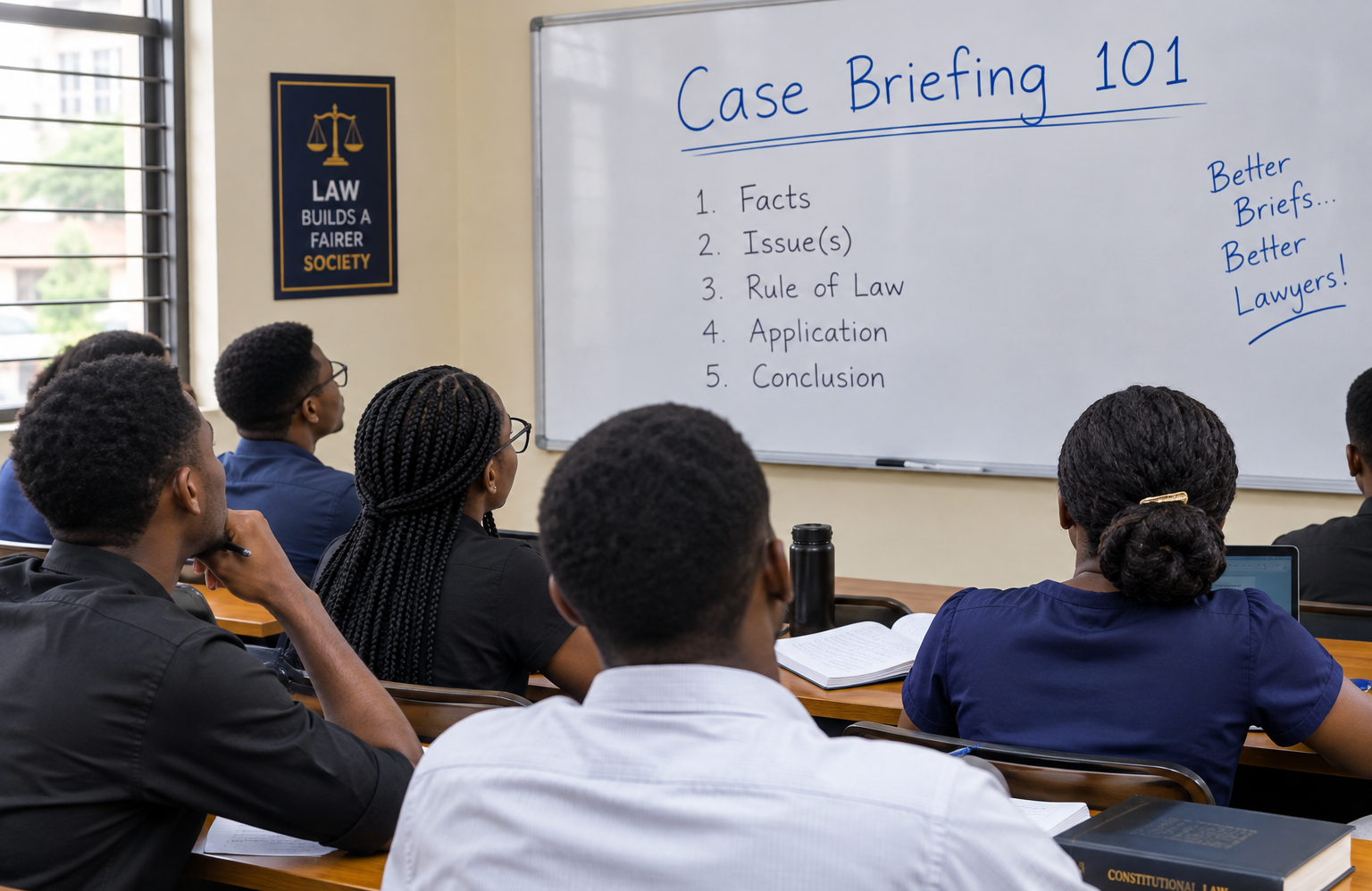
For every law student, reading dense appellate judgments running into dozens or hundreds of pages is a daily reality. However, simply reading a court case from start to finish without a structured method leads to cognitive overload, forgotten details, and frustration when preparing for class discussions or answering problem questions in law exams.
Learning how to brief a court case efficiently is the single most valuable foundational skill in legal education. A case brief is not a summary of the entire judgment. Don’t be misled. Instead, it is a clear, analytical breakdown of a court decision that isolates the core facts, legal issues, procedural context, and judicial reasoning.
To help law students master this essential legal skill, BrakoPowers Law Hub presents a simple, step-by-step guide to briefing court cases like a seasoned practitioner, complete with a practical sample brief below.
Step 1: Case Title and Citation
Start your case brief by writing down the official name of the case and its formal citation.
(a) Case Title: Clearly identify the parties involved in the suit. For example, in constitutional law, you might brief Tuffour v. Attorney-General or in civil procedure, Fofie v. Zanyo.
(b) Citation: Record the official law report reference, the year of the judgment, and the specific court that decided the matter (e.g., Supreme Court, Court of Appeal, or High Court). Recording the court level immediately tells you whether the decision constitutes binding judicial precedent or persuasive authority under the hierarchy of courts.
Step 2: Key Material Facts
Summarise the factual background of the dispute in your own words after carefully reading the full judgment.
(a) Focus strictly on material facts: those essential events, actions, or statutory breaches that directly gave rise to the legal dispute.
(b) Omit minor background details that have no bearing on the legal outcome. Rewriting the facts in clear, plain language ensures you truly understand what happened between the parties before entering the lecture hall.
Step 3: Legal Issues
Identify the specific legal questions that the court was asked to resolve.
(a) Frame the legal issues as direct questions that can be answered with a “Yes” or “No,” followed by a brief legal explanation.
(b) For example: “Whether or not the Speaker of Parliament violated Article 117 of the 1992 Constitution when he directed the service of court processes on a Member of Parliament.”
(c) Framing precise legal issues forces you to focus on the exact point of law being contested rather than getting lost in factual details.
Step 4: Legal Principles and Ratios (Ratio Decidendi)
Extract the core legal principles, statutory interpretations, and constitutional doctrines articulated by the court.
(a) Identify the ratio decidendi: the crucial legal rule or reasoning upon which the court’s final decision is based. This is the binding principle that creates judicial precedent for future cases.
(b) Distinguish the ratio from obiter dicta: passing comments, hypothetical illustrations, or peripheral observations made by judges that do not form part of the binding legal principle.
(c) Highlighting key legal principles gives you a ready-made repository of authoritative legal rules to cite in law school examinations and moot court pleadings.
Step 5: Holding and Judicial Reasoning
Record the court’s final determination of the legal issues and the detailed logic used by the bench to reach that conclusion.
(a) The Holding: State clearly how the court answered each legal issue (e.g., “Claim allowed,” “Appeal dismissed,” or “Injunction granted”).
(b) The Reasoning: Briefly explain why the court ruled the way it did. Outline how the judges applied statutory provisions, constitutional guarantees, or past precedents to the material facts of the case.
If there were dissenting or concurring opinions delivered by individual judges, note their key analytical points briefly, as dissenting opinions often foreshadow future shifts in judicial thought.
Practical Application: Sample Case Brief
To see how these five steps come together in practice, review this structured sample case brief of a landmark Ghanaian constitutional law decision:
CASE TITLE: Tuffour v. Attorney-General (Court of Appeal (sitting as the Supreme Court)
CITATION: [1980] GLR 637 (Date of Judgment: September 23, 1980)
FACTS OF THE CASE:
In this case, following the promulgation of the 1979 Constitution of Ghana, Justice Apaloo was serving as the incumbent Chief Justice. The President submitted Justice Apaloo’s name to Parliament for vetting and approval for the position of Chief Justice. Parliament vetted and subsequently rejected his nomination. Dr. Philip Tuffour (Plaintiff), a citizen of Ghana, invoked the original jurisdiction of the Supreme Court seeking a declaration that Justice Apaloo was already the substantive Chief Justice upon the coming into force of the 1979 Constitution and did not require vetting or approval by Parliament.
LEGAL ISSUES:
(1) Whether or not the Plaintiff had the legal standing (locus standi) as a citizen to invoke the original jurisdiction of the Supreme Court under the Constitution without demonstrating a direct personal interest.
(2) Whether or not the incumbent Chief Justice, who was in office prior to the 1979 Constitution coming into force, was required to undergo parliamentary vetting and approval to remain in office.
CORE LEGAL PRINCIPLES:
(a) Enforcement of the Constitution & Locus Standi: Any citizen of Ghana has the constitutional right and duty to defend and enforce the Constitution. A citizen does not need to show a personal, direct injury or proprietary interest to bring a constitutional action against the state.
(b) Living Document Principle: A Constitution is a living, organic legal document. It must be interpreted broadly and purposively to fulfil the intentions of its framers rather than through narrow, mechanical legalisms.
HOLDING:
The Court held that the Constitution is a dynamic, living instrument that must be given a generous and broad interpretation. On the issue of standing, restricting the right to sue to only those with personal injury would undermine constitutional supremacy. On the substantive issue, the Court reasoned that the transitional provisions preserved existing judicial appointments to ensure continuity and safeguard judicial independence from political interference by the executive or legislature.
Key Takeaway for Law Students
Briefing cases is not about rewriting the judgment. It is about distilling complex legal arguments into a structured, highly accessible format. By applying these five steps to every law report you read, you will dramatically improve your legal comprehension, save time during revision, and build the analytical mindset required to excel in law school and professional practice.
Stay Informed with BrakoPowers Law Hub
At BrakoPowers Law Hub, we deliver practical study guides, career guidance, and authoritative legal analysis across Ghana.
Explore more legal study guides and analytical articles at www.brakopowers.com and follow us on social media @brakopowerslawhub.
Be First to Comment