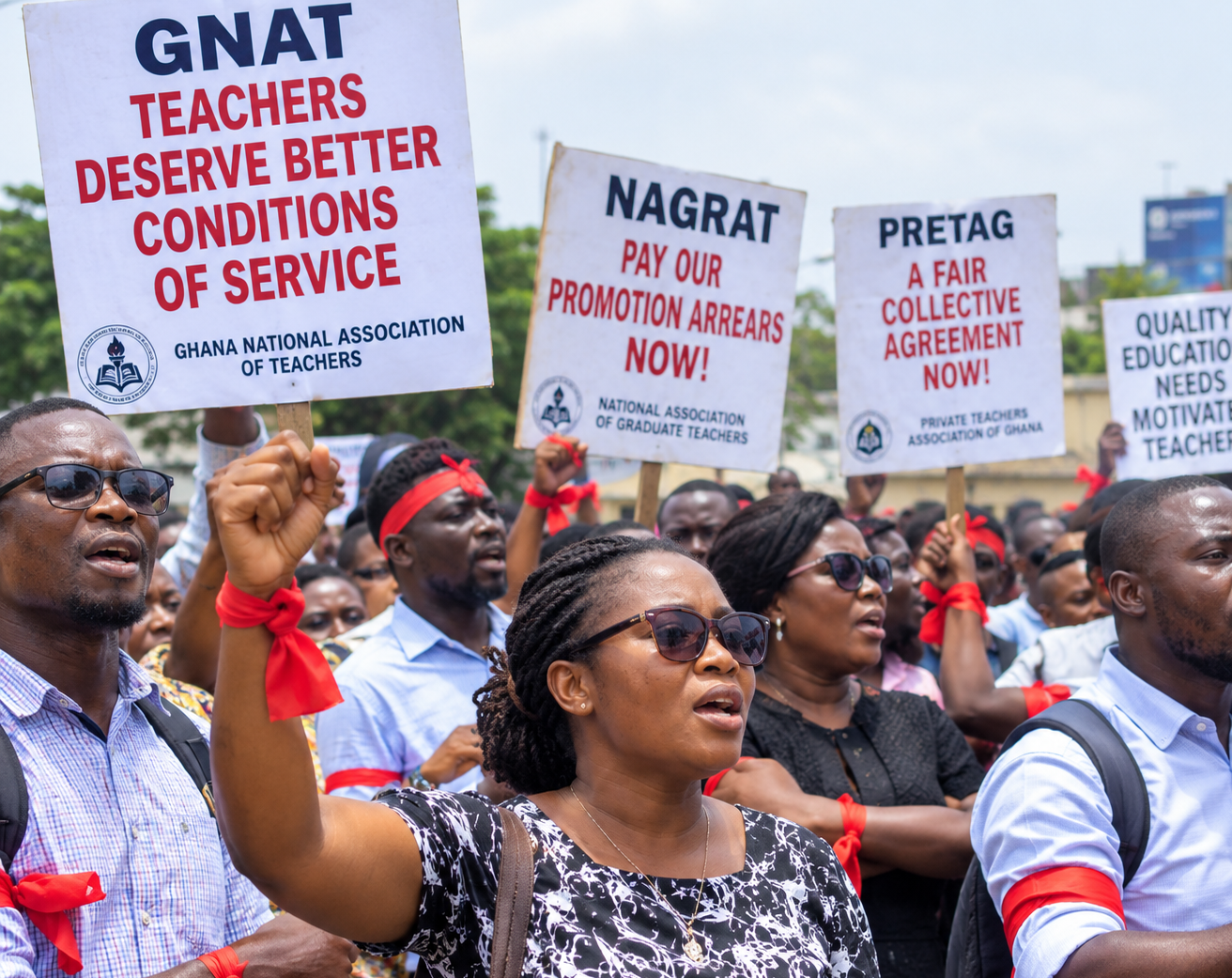
As nationwide industrial action declared by pre-tertiary teacher unions continues across Ghana, public debate has once again erupted over whether striking teachers are legally entitled to receive their monthly salaries.
The popular, knee-jerk reaction in labour disputes is often the slogan “no work, no pay.” However, under the Labour Act, 2003 (Act 651), the legal position is not that simple.
BrakoPowers Law Hub breaks down the statutory provisions governing strike actions, wage forfeitures, and employment security under Ghanaian labour law.
1. The Statutory Baseline: Illegal Strikes vs. Lawful Strikes
Whether striking workers are entitled to remuneration depends entirely on one core legal distinction: Is the strike lawful or illegal?
The Labour Act, 2003 (Act 651) establishes two separate rules based on this classification:
Forfeiture of Pay Under Illegal Strikes: Section 168(4)
Where a strike action is declared unlawful, Section 168(4) of Act 651 explicitly empowers the employer to withhold salaries or terminate employment:
“A worker who takes part in an illegal strike may have his or her employment terminated by the employer without notice or may forfeit his or her remuneration in respect of the period during which he or she took part in the illegal strike.”
Employment Rights Under Lawful Strikes: Section 169(1)
Conversely, where an industrial action complies with statutory procedures, Section 169(1) of Act 651 protects the foundational employment relationship:
“During a lawful strike or lockout, the employment relationship between the employer and the workers shall not be affected by the strike or lockout…”
Because a lawful strike does not sever or suspend the contractual employment relationship, an employer cannot simply assume an automatic right to impose “no work, no pay” without a formal determination of illegality.
2. When Does a Strike Become Unlawful Under Act 651?
For an industrial action to be classified as illegal under Ghanaian law, it must breach statutory procedure. Under Sections 159, 160, and 161 of Act 651, a strike becomes unlawful if:
(a) Failure of Notice: The mandatory seven-day written notice of intention to strike is not delivered to the employer and the National Labour Commission (NLC) prior to commencing action.
(b) Ongoing Negotiations or Conciliation: The strike is declared while compulsory negotiation, mediation, or arbitration proceedings are actively ongoing under the auspices of the NLC.
(c) Essential Services Prohibition: The workers involved belong to statutory essential services (such as healthcare, fire services, water, and electricity supply) where industrial action is strictly prohibited under Section 163 and the Schedule to Act 651.
3. Applying the Legal Framework to Current Negotiations
When evaluating whether teacher union salaries can be lawfully withheld, the key legal determination rests with the National Labour Commission (NLC).
Where negotiations between teacher unions and state bodies, such as the Fair Wages and Salaries Commission (FWSC) and the Ministry of Education, remain ongoing, the strike’s legal status dictates the remedy:
(a) If the NLC or a court of competent jurisdiction declares the strike illegal: Section 168(4) provides the legal foundation for the government to invoke the “no work, no pay” rule and withhold remuneration for the affected period.
(b) If the strike remains recognised as lawful or unresolved: The state cannot arbitrarily withhold remuneration without violating Section 169(1) of the Labour Act.
Conclusion: Ask the Right Legal Question
Public debate around industrial action must be guided by statutory text rather than emotion. Before declaring “no work, no pay,” the fundamental legal inquiry remains: Was the strike conducted in accordance with the procedural requirements of Act 651?
Without a clear legal finding of an illegal strike under Section 168(4), the statutory protections of Ghanaian labour law remain in force.
Stay Informed with BrakoPowers Law Hub
At BrakoPowers Law Hub, we deliver practical legal breakdowns, statutory guidance, and authoritative labour law commentary across Ghana.
Explore more legal guides and statutory analysis at www.brakopowers.com and follow us on social media @brakopowerslawhub.
Be First to Comment