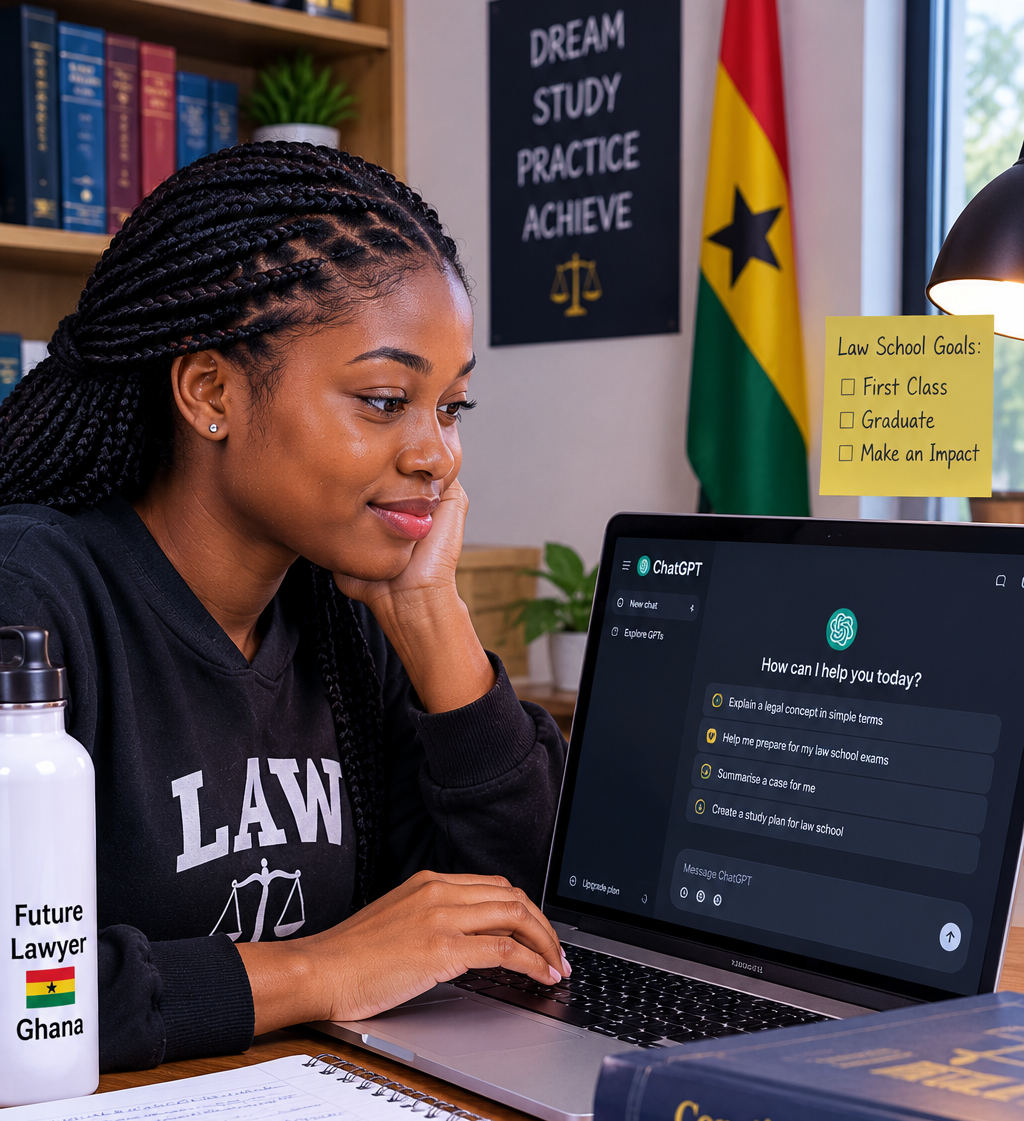
Are you using ChatGPT to make your brain sharper or because you’ve become too lazy to think?
In law school, the difference is fatal. It is tempting to paste an assignment prompt into ChatGPT, copy the output, and call it a day. But if that is your strategy, you are walking into an academic and legal trap.
AI should never become your brain; it should be your personal sparring partner. Here is the 5-step AI strategy to excel in law school using ChatGPT, without destroying your legal reasoning or relying on fake case law.
Rule #1: ChatGPT is not your ghostwriter. It is your 24/7 legal training partner.
1. Use AI as Your Personal 24/7 Law Tutor
When a lecturer introduces dense doctrines like consideration or promissory estoppel, reading a casebook three times can sometimes leave you more confused. Instead of asking generic questions (“What is consideration?”), use role-based prompts:
“Act as an expert law tutor. Explain the doctrine of consideration in contract law as if I am a first-year Ghanaian law student. Give me three practical, real-world examples.”
Follow up by asking it to explain in simpler terms or to provide a local Ghanaian market scenario. You aren’t asking AI to think for you—you are using it to break down complex concepts until your brain clicks.
2. Stop Passive Reading – Force Active Recall
Underlining textbooks in yellow for four hours creates the illusion of learning. But recognition is not understanding; reading a page ten times doesn’t mean you can apply it under exam pressure.
Use ChatGPT to run Active Recall quizzes:
“Quiz me on the Law of Torts, specifically Duty of Care. Ask me ONE challenging problem question at a time. Do not give me the answer until I attempt it.”
Making mistakes in private forces your brain to adapt so you don’t make those same mistakes in the examination hall.
3. Turn ChatGPT into Opposing Counsel
A average student asks, “Why am I right?” A great lawyer asks, “What is the strongest argument against me?” Once you draft an answer to a problem question, force the AI to attack your reasoning:
“Act as Opposing Counsel in a Ghanaian High Court. Here is my legal submission on breach of contract: [Paste Draft]. Attack my argument. Identify every loophole, weak authority, and missing argument.”
Letting the AI expose your weak points in study sessions prevents a judge or lecturer from doing it in court or during grading.
4. VERIFY EVERYTHING (The Golden Rule)
ChatGPT hallucinates. It can cite cases that do not exist, fabricate judgments, or invent statutory sections with complete confidence.
Submitting an assignment with a hallucinated authority like Republic v. Mensah [2024] will ruin your academic credibility.
Never cite an AI-generated legal authority without verifying it in a real Law Report or statute book.
AI can show you where the road might be, but you must check that the road actually exists.
5. Critique Your Writing. Never Outsource It
Asking AI to generate your five-page essay cheats you out of building critical legal writing skills. When you sit in an exam hall, there is no internet. It’s just you, your pen, and your brain.
Write your draft first, then ask ChatGPT for feedback:
“Act as a strict law professor. Critique my legal writing below. Point out structural errors, poor IRAC formatting, or weak legal reasoning. DO NOT rewrite it for me. Tell me what is wrong so I can fix it myself.”
The lawyer of the future won’t just be the person who uses AI. It will also be the person who knows when to use AI, and when to rely on independent legal reasoning.
Ready to Master Law School? At BrakoPowers Law Hub, we help law students and young professionals master Ghanaian law, excel in exams, and think like advocates.
Be First to Comment